
TL;DR
- Reply speed starts to feel like a signal when the rules are unclear. In early dating, a quick answer can look like interest and a delay can look like rejection, even though response time also reflects work, habits, attention, and plain old life.
- Judge patterns, not pauses. One slow reply tells you little. A change in rhythm, one-sided effort, and repeatedly dodged plans tell you much more. Follow up once when you need clarity; continued silence is information too.
- Aim for a rhythm you can explain. Keep enough continuity that the other person isn’t left hanging, protect normal offline time, and move meaningful conversations to a call or date before text has to carry the whole relationship.
Texting anxiety in dating often starts with one ordinary pause: you send a message, the reply doesn’t come, and suddenly you’re reviewing the last three things you said. The pause feels like a test because early dating rarely comes with a shared rule for how fast either person should answer. The useful question is whether you’re seeing a normal delay, a mismatch you can discuss, or a repeated pattern of withdrawal.
Why Does Reply Speed Feel Like a Measure of Interest?
Reply speed becomes a stand-in for interest when you don’t yet have much else to judge.
A recent experiment tested how timing shapes that signal after a promising first date. Following a 100-person pre-study, 543 participants received the same message either immediately, the next morning, or two days later. The two-day delay produced lower chemistry and motivation than either earlier message, while the next-morning message produced the highest relationship intentions (Teichmann et al., 2026). Two caveats: it’s a single, unreplicated study, and people only imagined a date and reacted to timing alone — no real message content. So it’s suggestive, not proof. It does show why timing can look like evidence of reciprocity when a connection is new.
That’s the trap. You can see the timestamp, yet you can’t see the meeting, commute, headache, dead battery, or thought behind it. So your brain fills in the missing context:
- “They answered in a minute, so they must really like me.”
- “They were online and didn’t reply, so I said something wrong.”
- “If I double text, I’ll look too interested.”
- “If I answer now, I’ll seem as if I have nothing else going on.”
None of those readings is impossible. None is reliable from timing alone. The less relationship history you have, the more meaning one visible cue is asked to carry.
Then the conversation becomes a performance. You’re choosing words for an imagined score: funny enough, relaxed enough, interested but not too interested. Generic rules such as “wait twice as long as they did” add another stopwatch. They don’t tell you whether the connection is healthy; they tell you how well both people can act unbothered.
How Can You Tell a Slow Reply From Someone Pulling Away?
A slow reply is one event. Pulling away is a pattern that shows up across effort, consistency, and follow-through.
Ghosting is common enough to make a pause worth examining. In a nationally representative survey of 4,860 U.S. adults, 29% said someone they had dated had suddenly stopped answering without explanation. The figure rose to 53% among people with online-dating experience and 62% among those who were online dating at the time (Pew Research Center, 2020). The survey didn’t define ghosting by a number of hours. Silence gets its meaning from what came before it.
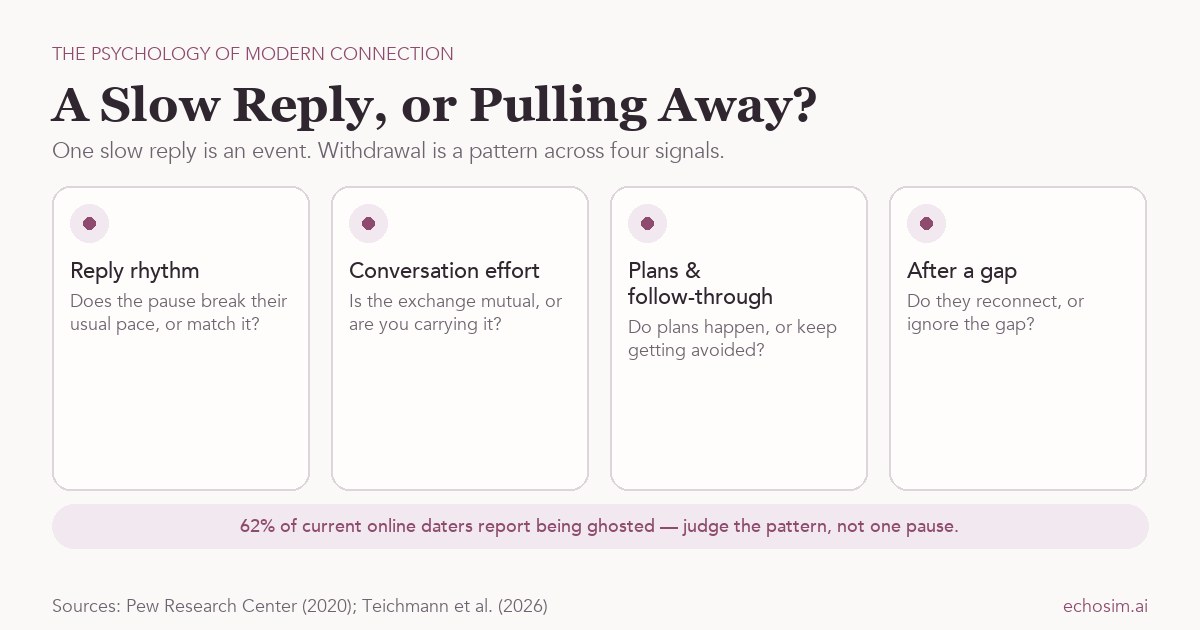
When clarity matters, one follow-up is usually enough: “Still up for Saturday?” or “I enjoyed meeting you — would you like to do it again?” You’re following up on the connection, not apologizing for wanting an answer.
If that message also gets silence, or the person repeatedly reappears without answering the question, you have enough information to step back. You don’t need a courtroom verdict on whether it “counts” as ghosting. If contact feels unsafe or coercive, skip the follow-up and block. Closure is never more important than safety.
How Often Should You Text When You’re Dating Someone New?
Text often enough to create continuity, then let the relationship gather evidence outside the chat.
There isn’t a research-backed number of texts per day that fits every couple. In a survey of 395 partnered university students with a mean age of 19.3, the sheer volume of texts had little association with relationship satisfaction. The share of texting relative to face-to-face and other communication was negatively associated with satisfaction (Luo, 2014). The study was correlational and did not focus on early dating, so message count remains a poor target rather than a rule — and that texting-share effect may be situational: a 2021 study of 647 people found frequent texting tracked higher satisfaction in long-distance couples, but not when partners lived nearby (Holtzman et al., 2021).
Try four practical checks instead of counting messages:
- Can your pace be predicted? You don’t need a schedule. A simple “work is packed; I’ll reply tonight” gives a pause context.
- Does each person have room to live? A healthy exchange can survive class, work, sleep, friends, and a phone left in another room.
- Is the content going somewhere? A few messages that reveal something real can do more than an all-day loop of status updates.
- Does text lead to richer contact? When it’s safe and practical, use a call, video chat, or in-person date to learn what timing and punctuation hide.
This is intentional pacing: enough consistency to make a normal pause recognizable, enough autonomy to answer like yourself, and enough movement that texting doesn’t become the entire relationship. It keeps you from mistaking constant contact for compatibility, or repeated uncertainty for potential.
If you’re weighing how much to trust the signals you have, it helps to separate what a profile can tell you from what interaction reveals — here too, match your certainty to the quality of the evidence.
FAQ
How long is too long to wait for a text when dating?
There is no universal cutoff. Compare the delay with the person’s normal rhythm and the urgency of the message. A late reply during work is different from repeated silence around a direct invitation.
What should I do if I think I’m being ghosted?
Send one clear follow-up if you need an answer or have a plan to confirm. If that also gets no response, stop pursuing the conversation. Continued silence already tells you the connection lacks the reciprocity you need.
Is double texting a bad idea?
No. Send a second message when you have a useful follow-up, need to confirm a plan, or genuinely want to reconnect. If you’re repeatedly double texting just to get any response, the imbalance is more informative than the supposed rule.
Should I match the other person’s response time?
Forced mirroring creates strategy, not clarity. Reply when you have the time and attention to say what you mean. If your natural rhythms are far apart, talk about it directly instead of turning delay into a guessing game.
How do I stop overthinking a slow text reply?
Check whether the delay actually breaks the person’s normal pattern. Follow up once if a plan or direct question needs an answer, then stop checking status indicators for new evidence. Judge the connection by reciprocity and follow-through over time.
Conclusion: Make Silence Easier to Read
There is no single “healthy” texting pace. A workable rhythm gives both people continuity, room to live, and a clear sense of whether the effort is mutual.
Count patterns, not messages. Do they answer direct questions, follow through on plans, and put in effort too? Ask clearly once when you need an answer. One missing reply can hurt, but it doesn’t say anything about your worth. Repeated one-sided silence tells you much more than a single pause.